Rent a Bounce House With Slide: What Parents Need to Know
There is a reason kids lock onto a bounce house the second they see one. It is bright, loud, a little chaotic, and completely irresistible. Add a slide and the appeal doubles. Suddenly the party has a center of gravity. Shoes pile up by the entrance, a line forms at the ladder, and the adults get a rare chance to finish a sentence.
If you are thinking about booking one for a birthday, school event, neighborhood gathering, or family reunion, it helps to know what you are actually renting. A bounce house with slide is not just a bigger jumpy house. It changes the flow of the party, the amount of supervision you need, the setup requirements, and the price. In some cases, it is absolutely worth the extra money. In others, a standard inflatable is easier, safer for the guest mix, and less stressful on a tight yard.
Parents often start with the fun part, which theme the kids will like, whether to get a bounce house water slide, whether a castle looks better than a tropical combo. The better starting point is more practical. How many children are coming, what ages will be there, where will it go, and who is responsible if weather turns or a child gets hurt? Those questions matter more than the banner on the front.
Why the slide changes everything
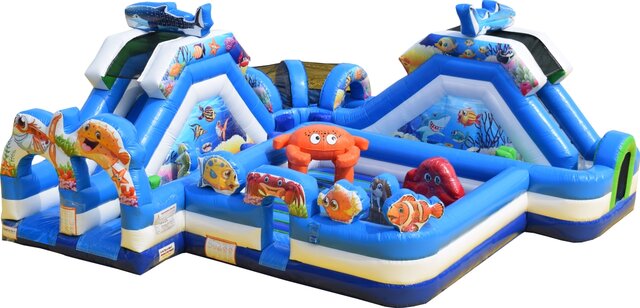
A basic bouncer house lets kids jump, tumble, and burn energy in one contained area. A combo unit, often called one of the combo bounce houses, adds a climbing wall and slide to that setup. Some also include basketball hoops, pop-up obstacles, tunnels, or a mini bounce house obstacle course element inside.
That sounds like a small upgrade, but in use it feels very different. Kids tend to circulate instead of colliding. One group bounces, another climbs, another slides down and runs around to do it again. For parties with active children who get bored quickly, that loop keeps them occupied much longer than a simple square inflatable.
The trade-off is that slides create traffic patterns. Children bunch at the entrance, race to the ladder, and sometimes ignore age or size differences when they are excited. I have seen a standard bounce unit run smoothly with a mixed group of preschoolers and older siblings, then the same crowd turn into a management project once a rent bounce house slide was involved. Nobody was misbehaving. The structure simply encouraged more movement, more speed, and more competition.
That does not mean you should avoid bounce houses with slides. It means you should think like a host, not just a shopper. The right inflatable can make a party easier. The wrong one can create constant bottlenecks and require an adult to stand there all afternoon acting as traffic control.
The most important question is age mix
When parents ask whether they should rent bounce house with slide options or stick to a plain inflatable bounce house for rent, my first question is always the same: how old are the kids?
For toddlers and younger preschoolers, a smaller combo with a short slide can work well, especially if the guest list is mostly children under five. They love the novelty, and they do not need a towering structure to have fun. In fact, smaller is often better because the floor feels less overwhelming and the slide is easier to use confidently.
For elementary-age kids, bounce house rentals with slides are usually the sweet spot. Ages five through nine are often ideal. They have the coordination to climb and slide safely, and they still find the commercial bounce house with slide inflatable itself exciting enough that you do not need extra entertainment stacked on top of it.
For older children, the size and style matter more. A tiny birthday unit that looks huge in the rental photo can feel babyish in person to a group of ten-year-olds. That is when a larger combo, a taller dry slide, or even a bounce house obstacle course setup tends to hold attention better.
Mixed-age groups are where parents most often run into trouble. A six-year-old and a three-year-old should not always be bouncing together, and they definitely should not be charging the same slide ladder at the same time. If your party includes toddlers plus older siblings or cousins, you may need a plan to separate play by age in shifts. That sounds formal, but in real life it can be as simple as letting the youngest kids have the first half hour while older children eat cake or do another activity.
Yard size matters more than people expect
Many people imagine they have enough space because the lawn looks big. Then the rental company asks for dimensions, including clearance on the sides, room for stakes or sandbags, access for setup, and distance from fences or low branches. That is when the tape measure comes out.
A bounce house with slide almost always needs more footprint than a basic inflatable, but the footprint is not the whole story. You also need safe circulation space around it. Children will run around the back. Parents will stand off to the side. Someone will leave a stroller or gift table too close unless you intentionally plan the layout.
Power is another detail that catches people off guard. Most inflatables need a dedicated outlet within a reasonable distance for the blower. If the only outlet is across the house, you may need a heavy-duty extension cord, and the rental company may have specific rules about that. You also do not want the circuit sharing power with a refrigerator in the garage, a sound system, and a cotton candy machine. A tripped breaker in the middle of a party is memorable for all the wrong reasons.
Surface matters too. Grass is the easiest. It is forgiving, stable, and usually simplest for anchoring. Concrete, asphalt, turf, and indoor floors can still work, but the setup method may change. Some companies use sandbags rather than stakes. Some units are not approved for certain surfaces at all. Ask before booking, not the night before.
Wet or dry, decide early
The phrase bounce house water slide covers a lot of ground. Some inflatables are designed specifically for water use. Others are dry-only units with slides that look like water slides in the pictures. Some combo bounce houses can be used either way, depending on the season and the setup package.
Water adds excitement, especially in hot weather, but it also adds complexity. Clothing gets soaked. Grass turns muddy. The slide lane becomes slicker, which is the point, but also raises the supervision level. Children track water into bathrooms and through the house unless you have a clear outdoor transition zone. The party can become less birthday gathering and more backyard pool day, which is wonderful if that is what you want.
Dry slides are simpler to manage and often better for cooler months, shorter rental windows, or parties where families are not expecting swimsuits and towels. They also work better for younger children who may not love the surprise of being drenched by a splash pool at the bottom.
The best choice usually comes down to weather, guest expectations, and cleanup tolerance. If it is a ninety-degree day and you have a yard that can handle it, a bounce house water slide is a huge hit. If your party starts late afternoon, the weather is iffy, or you do not want everyone wet during cake and presents, dry may be the smarter move.
Safety is not a buzzkill, it is what makes the party fun
Most inflatable accidents do not happen because a unit is inherently dangerous. They happen because the match between the equipment, the crowd, and the supervision is poor. A reputable rental company reduces some risk by cleaning and inspecting equipment, securing it properly, and giving clear use instructions. The host still sets the tone.
A few rules make a big difference:
- Separate kids by size and age when possible.
- No flips, wrestling, or climbing on exterior walls.
- One at a time on the slide if the unit requires it.
- Shoes, sharp objects, food, and drinks stay out.
- Stop play immediately if high winds or lightning move in.
Those are simple rules, but they only work if an adult is actually watching. “Watching” does not mean chatting across the yard while glancing over every few minutes. The busiest moments are when children first pile in, when an older child starts showing off, and when adults get distracted by serving food.
One parent I know thought a combo unit would occupy the kids so the grownups could relax. In one sense, it did. In another, it created a rotating need for supervision because the smallest guests kept trying to follow the biggest ones up the ladder. They solved it by assigning two adults in twenty-minute shifts. Once someone was clearly in charge, the whole event felt calmer.
What separates a good rental company from a risky one
The bounce house itself matters, but the operator matters more. When you rent bounce houses, you are trusting someone else’s maintenance standards, scheduling, and setup practices. That is not the place to choose purely on the lowest price.
Ask how the unit is cleaned and inspected between rentals. Ask whether setup and takedown are included. Ask how they anchor inflatables on your specific surface. Ask what happens if weather forces cancellation. You do not need a polished sales pitch. You want direct, confident answers.
Good companies tend to ask you smart questions too. They will want to know the event date, location, surface type, access path, age range, and whether there are gates, stairs, slopes, or overhead obstructions. If someone seems ready to book without asking any of that, treat it as a warning sign.
Insurance and local requirements vary, so it is reasonable to ask what coverage they carry and whether there are permits or venue rules involved. If you are hosting at a park, school, church, or HOA common area, those restrictions matter. Some sites do not allow stakes. Some require proof of insurance. Some do not provide power at all.
Delivery windows are worth discussing in detail. Parents often picture a precise drop-off time. In reality, many bounce house rentals operate on routes, so setup may happen several hours before the party. That is usually fine, but you should know it in advance so you are not still trying to decorate where the blower needs to go.
Price, and why the cheapest quote is not always cheaper
Prices vary a lot by region, season, duration, and unit size, so broad ranges are more honest than exact numbers. In many markets, a basic bouncy house rental may start at a lower tier, while a larger combo with a slide costs noticeably more. Water-capable units, oversized slides, and obstacle-course style inflatables usually move up again. Delivery distance, weekend demand, holiday timing, generator rental, and attendant service can all add to the total.
What parents sometimes miss is value per child hour. If a plain jumpy house is cheaper but loses the kids after forty minutes, while a combo keeps them happy for three hours, the math changes. The more useful comparison is not only the rental fee, but how much entertainment problem-solving it saves you. If the inflatable replaces extra games, hired performers, or constant adult improvisation, a higher price may be justified.
On the other hand, paying for the biggest unit on the website is not automatically money well spent. I have seen giant inflatables dominate small backyards so completely that there was barely room left for tables, shade, or a clear path to the house. The party looked impressive in photos and felt cramped in person. Bigger is better only when the space, guest count, and age range support it.
Theme matters less than function, but it still matters
Children absolutely notice theme. Princess castles, tropical slides, superheroes, farm animals, rainbow designs, and neutral bright colors all create a different mood. If your child has a strong opinion, the theme can be part of the magic.
Still, after the first two minutes, function takes over. Kids care more about whether the slide feels fast, whether the entrance is easy to navigate, and whether they can repeat the loop without waiting too long. A visually perfect unit that is too small for your guest list will frustrate them. A less customized combo that flows well will usually win.
If you are trying to balance aesthetics with practicality, ask for actual dimensions and real event photos, not only catalog images. Some inflatables photograph larger than they feel. Some have very steep ladders or narrow bouncing areas hidden by camera angles. A quick conversation can reveal whether the unit really suits your party.
Weather can ruin plans, so handle it upfront
Inflatables and weather have a fragile relationship. Light warmth and a calm day are ideal. Strong wind is the major concern, followed by lightning and heavy rain. Heat matters too, particularly on dark slide surfaces and enclosed bounce areas that can get stuffy.
The smartest move is to discuss weather policy before you reserve. Can you reschedule for rain? Is there a deposit? What happens if conditions are unsafe on the morning of the event? Policies differ, and it is easier to accept one when you knew it ahead of time.
If the forecast is uncertain, think through alternatives. A garage setup may not be possible if the ceiling is low. An indoor venue may not allow inflatable equipment. Moving the cake table under a tent solves one problem but not the wind issue for the inflatable itself. Having backup activities for the kids is not glamorous, but it protects your sanity if the skies turn.
The party flow around the inflatable
A bounce house with slide often becomes the main event, which means the rest of the party should work around it rather than compete with it. This is where a little planning pays off.
If you schedule cake the minute children arrive, half of them will stare past you at the inflatable. If you open gifts while everyone is sweaty and impatient from bouncing, the birthday child may end up opening presents to an audience of three. Usually it works better to let the inflatable do its job first, then pull kids away briefly for food, cake, or a group moment once the initial excitement has settled.
Placement matters here too. If the unit is visible from the food table, expect children to inhale one bite and sprint back. That is not necessarily bad, but it helps to know what kind of party rhythm you are choosing.
One practical approach that works well is this:
- Let kids bounce soon after arrival while guests settle in.
- Serve simple food that can be eaten quickly and without much mess.
- Pause play for cake when energy starts to dip a bit, not at peak excitement.
- Save presents for later, or skip a public gift-opening if your child gets overwhelmed.
- Build in a few quiet minutes before pickup so everyone does not leave overstimulated.
That rhythm is not mandatory, but it reflects how these parties tend to go in real life. The inflatable sets the pace. Fighting that pace usually leads to frustration.
Common mistakes parents make on the first rental
The biggest mistake is underestimating supervision. The second is guessing on space instead of measuring. After that, it is usually a tie between booking for the wrong age group and overlooking logistics like power, access, or weather policy.
Another common issue is forgetting the human side of the event. A giant inflatable can be thrilling for some children and intimidating for others. The child who begged for a huge slide may be the same child who freezes at the top when twenty cousins are waiting behind them. Giving kids permission to take their time, or even not participate immediately, makes the party feel safer emotionally as well as physically.
Parents also sometimes assume setup is instant. It is fast once the crew starts, but the broader process takes planning. Gates need to open. Cars may need to move. Pet waste needs to be cleared from the yard. Sprinklers should be off. If there has been rain, a soggy patch in the only usable area may change everything.
Is a bounce house with slide worth it?
For many families, yes. A well-chosen combo unit can carry an entire birthday party with surprisingly little extra entertainment. It creates motion, excitement, and enough novelty that even children who have “seen bounce houses before” usually dive right in. If the ages are right and the space works, it is one of the easiest ways to give a party a clear focus.
But it is worth it only when the practical pieces line up. The right size, the right supervision, a reputable company, decent weather, and realistic expectations matter more than the fanciest design. If your crowd is mostly toddlers, your yard is tight, or your goal is a low-key gathering, a smaller inflatable or even no inflatable at all may serve you better.
The best rentals feel effortless to guests because the adults handled the unglamorous details ahead of time. Measure the yard. Ask direct questions. Match the unit to the children, not to the photo. Then let the kids do what kids do best, bounce until their hair sticks to their foreheads, line up for “just one more turn,” and end the day tired in the most satisfying way possible.